

ב"ה
Bo 5765 - January 14, 2005

The Moon and Us
To an ancient Greek or a Hindu, passive stillness is masculine, activity and motion are feminine. To a Taoist, action is masculine and passiveness is feminine. In other words, if it is a virtue it is masculine. The Jew turns the pyramid on its head
To an ancient Greek or a Hindu, passive stillness is masculine, activity and motion are feminine. To a Taoist, action is masculine and passiveness is feminine. In other words, if it is a virtue it is masculine. The Jew turns the pyramid on its head
Parshah

Bo in a Nutshell
G-d commands the first mitzvah: the calendar. The final three plagues are visited about the Egyptians: locusts, darkness and death of the firstborn. Pharaoh finally cracks and sends the Jewish people running. The holiday of Passover and the Passover offering are introduced.
G-d commands the first mitzvah: the calendar. The final three plagues are visited about the Egyptians: locusts, darkness and death of the firstborn. Pharaoh finally cracks and sends the Jewish people running. The holiday of Passover and the Passover offering are introduced.
Story
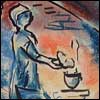
Eating Stones
Proudly the rich man described to the Chassidic master his one daily meal, in which and ate and drank nothing more than bread with salt and a jug of water
Proudly the rich man described to the Chassidic master his one daily meal, in which and ate and drank nothing more than bread with salt and a jug of water
Living
Can You Prove You're Not a Machine?
In the old days, we were always asking the opposite question: the biology assignment was to prove that a car is not a living organism. But modern life has turned the question around...
In the old days, we were always asking the opposite question: the biology assignment was to prove that a car is not a living organism. But modern life has turned the question around...

What Does G-d Need Us For?
If G-d is perfect, why did He create us? A perfect being isn't missing anything, so why would He need us?
If G-d is perfect, why did He create us? A perfect being isn't missing anything, so why would He need us?

The Kabbalah of Darkness
When confronted with darkness, what do you do? fight it? peer more deeply into it? A dual lesson from the Plague of Darkness that afflicted the Egyptians
When confronted with darkness, what do you do? fight it? peer more deeply into it? A dual lesson from the Plague of Darkness that afflicted the Egyptians
A Suburbanite in Sri Lanka
Logically, such an apparently senseless tragedy should lead us further away from belief in the Providence and Oneness of a good, loving and omnipresent G-d. Yet it has had the opposite effect. Why?
Logically, such an apparently senseless tragedy should lead us further away from belief in the Providence and Oneness of a good, loving and omnipresent G-d. Yet it has had the opposite effect. Why?
"A man saw not his fellow, neither rose any from his place for three days" (the Plague of Darkness, Exodus 10:23). Indeed, there is no greater darkness than one in which "a man saw not his fellow" -- in which a person becomes oblivious to the needs of his fellow man. When that happens, a person becomes stymied in his personal development as well -- "neither rose any from his place."
— Chassidic master Rabbi Yitzchak Meir of Ger (1789-1866)
Print Magazine
It’s G-d’s world. Everything He gives is good, the sweetest good.
But it is often a good far too great for us to understand. We imagine it is not good, because that’s the only way to make sense of it with our small minds.
Yet the truth is, He gives us all the good we can handle. If we could take more, He would g...


New on ChabadofBinghamton.com